
Nurse Educators at the Heart: Guiding the Nursing Journey from Licensure to Leadership
by Kaplan Nursing | January 7, 2026
Every nurse’s journey begins with a calling, but it’s educators who help turn that calling into a career. From the first day in the classroom to the moment a nurse steps into leadership, your influence shapes not only what students know, but how they care, decide, and grow.
This guide follows that journey stage by stage. You’ll see where your role has the greatest impact and how proven tools can help extend your teaching, strengthen outcomes, and prepare students for the realities of practice. It’s a roadmap to support you in what you already do best: guiding nurses to succeed at every step.
For a visual overview, see the infographic at the end of this article.
Admission & Pre-Licensure: Building the Foundation for Nursing Education
For aspiring nurses, the admission test is often the first big moment—a mix of hope, nerves, and excitement. Once enrolled in ADN and BSN programs, students begin building the knowledge and skills that will shape their future practice.
Educators lay the foundation by teaching students to think critically, exercise sound judgment, and make ethical decisions that will guide their care. They bridge classroom learning with hands-on practice so learners are prepared not only to pass exams but to care with purpose.
Strengthening this foundation starts with assessment and preparation tools. The Kaplan Nursing Admission Test, Integrated Testing & Curriculum resources, and Kaplan NCLEX® Prep programs give students structured opportunities to reinforce classroom lessons and build momentum on their path to licensure. With these resources, educators can spend more time focusing on mentorship and building confidence in their students.
The result: NCLEX-RN first-time pass rates average 97% with Kaplan resources, compared to 89% nationally (NCSBN 2024 Examination Statistics, Kaplan data).
Transition to Practice: Supporting New Nurses with Educator-Led Preparation
The move from classroom to clinical practice is one of the most vulnerable and defining moments for new nurses. Structured residency and onboarding programs provide stability, while educators adapt their teaching to reflect the fast-changing realities of care delivery.
Bridging the gap between study and practice begins with experience that feels real but carries no risk. Kaplan’s i-Human Patients virtual simulations let learners apply reasoning and decision-making in lifelike scenarios before they step onto a unit. Paired with Learning-Integrated Coaching solutions, educators can extend this preparation, giving students the confidence to thrive in their first roles. For educators, that means more ways to reinforce lessons and reduce the uncertainty students often feel in their first months of practice.
The impact is clear: organizations with structured transition programs see a 91% nurse retention rate (Premier, Inc., From Bedside to Bottom Line, February 2025).
Continuing Education: Lifelong Learning in Nursing
Nursing is a profession of lifelong learning. While continuing education ensures compliance, great educators encourage nurses to pursue opportunities that close practice gaps, adapt to new technologies, and strengthen care quality.
Keeping this momentum alive means making knowledge accessible. With Kaplan Continuing Professional Development, Point-of-Care Clinical Professional Development, and real-time updates from Breaking Med, educators can connect learners to resources that are timely, relevant, and easy to fit into a busy schedule. These tools make it simpler for educators to spark curiosity, address learning gaps, and sustain professional growth.
And many employers are investing as well: 51% of nurses report access to reimbursed or paid continuing education (Relias 2024 Nurse Salary and Wellness Support Report).
Specialization & Certification: Preparing Nurses for Advanced Roles
As nurses discover their clinical passions, educators guide them toward specialties where their strengths and ambitions align. Certification becomes more than a test; it’s a gateway to advanced roles and leadership within a chosen field.
Preparation for this step means practicing with purpose. Kaplan FNP Exam Prep courses and Kaplan AGNP QBanks help learners sharpen their skills, deepen understanding, and enter exams with confidence built through meaningful practice. For educators, these resources provide reliable ways to connect classroom learning with the specialized skills required in practice.
And the opportunities are growing: nurse practitioner employment is projected to increase 46% between 2023 and 2033 (U.S. Bureau of Labor Statistics, April 2024).
Advanced Nursing Degrees: Guiding the Next Generation of Leaders
From MSN to DNP and Ph.D., advanced degrees open doors to leadership, research, and academia. Nurse educators mentor learners through these demanding programs, shaping the professors, policymakers, and innovators who will carry nursing into the future.
Progressing to this level requires both guidance and advanced practice. Resources like Kaplan’s i-Human simulations, AANPCB exam prep resources, and ANCC prep tools give graduate-level learners the tools to master complex coursework and move forward in their academic and professional milestones. For educators, these resources extend mentorship into advanced programs, making it possible to prepare future leaders with both knowledge and confidence.
Yet the need remains pressing: only 1.9% of nurses currently hold a doctoral degree (National League for Nursing, Value Statement on Workforce Demands of the Future).
Why Nurse Educators Remain Central to the Nursing Journey
At every stage, educators are the heart of nursing. With Kaplan’s nursing education solutions, including classroom resources, simulations, and continuing education, they have what they need to guide students from the first admission test to the final credential—keeping the rhythm steady the whole way.
Educator’s Guide: Common Questions on NCLEX, Onboarding, and Continuing Education
How can I improve NCLEX first-time pass rates as a nurse educator?
Short answer: Frequent assessments, focused practice, and real coaching move the needle. Kaplan NCLEX Prep and Integrated Curriculum resources provide structure for steady gains.
Expanded context: Building on that structure, early diagnostics surface weak spots before stress peaks. Small wins paired with feedback create confidence, which can be as critical as content mastery when students face high-stakes exams.
What are the best virtual patient simulation platforms for nurse educators?
Short answer: i-Human Patients offers lifelike cases so students can practice clinical judgment without risk.
Expanded context: By extending classroom lessons into these realistic decision points, learners connect theory with practice. They can make mistakes safely, and reflect, and correct them. This is a powerful confidence builder before stepping into clinical rotations.
How do I support new nurses making the transition into clinical practice?
Short answer: Pair a residency or onboarding program with coaching and simulation; Learning-Integrated Coaching and i-Human simulations ease the first year and support retention.
Expanded context: When those supports are in place, reflection and deliberate practice reduce anxiety and shorten the “time to confident.” Teams notice the difference when new nurses feel guided instead of left to figure it out alone.
Why should nurse educators emphasize continuing education and professional development?
Short answer: CE keeps skills current amid fast-moving tech and evidence. Kaplan Continuing Professional Development and Breaking Med make updates practical to access.
Expanded context: These resources turn lifelong learning into a sustainable habit. With timely, bite-size content that fits busy schedules, educators can help nurses close practice gaps and maintain quality care.
How can I guide nurses toward specialization and certification?
Short answer: Align strengths with goals, then use targeted prep like Kaplan FNP Exam Prep and AGNP QBanks.
Expanded context: Once learners see a path forward, structured practice turns preparation into confidence. Certification becomes more than an exam—it’s a milestone that opens doors to advanced practice and leadership roles.
What strategies should nurse educators use when teaching advanced practice (MSN/DNP) students?
Short answer: Combine complex simulations with AANPCB exam prep or ANCC resources, alongside strong mentorship.
Expanded context: In practice, this balance of rigor and support sharpens reasoning skills while preparing learners for exams and leadership expectations. Graduate students often thrive when they’re challenged, but know mentorship is there when they need it.
How do I build or improve structured residency and onboarding programs?
Short answer: Blend simulation, guided reflection, and mentorship; it strengthens readiness and workforce stability.
Expanded context: Extending beyond orientation checklists, programs that emphasize progressive competencies and consistent debriefs create nurses who feel supported from day one—and who stay longer in the profession.
Which assessment tools work best for pre-licensure nursing students?
Short answer: NCLEX-aligned diagnostics and curriculum assessments (e.g., Kaplan Admission Test) identify gaps early.
Expanded context: With those insights, educators can target critical thinking and judgment well before capstone courses or board exams, helping students approach licensure with less stress and stronger skills.
How can nurse educators integrate AI, simulation, or technology into the nursing curriculum?
Short answer: Start small—add adaptive quizzes or a few simulations—then scale. i-Human folds into existing courses without disrupting flow.
Expanded context: Introducing tech this way makes it an extension of teaching rather than a disruption. Over time, students and faculty both see it as a natural part of the learning process.
Why are nurse educators essential to retention, leadership development, and workforce sustainability?
Short answer: Educators shape every stage—from admission to leadership—and their mentorship drives confidence and stay-rates.
Expanded context: That influence is what sustains the profession. When learners feel prepared and supported, they succeed on exams, remain in the workforce, and step into the leadership roles nursing urgently needs.
Nurse Educator Journey Infographic: From Licensure to Leadership
This infographic highlights the essential role of nurse educators in guiding students through every stage of the nursing journey — from admission and licensure to advanced practice and leadership. It offers a big-picture view of how teaching, mentorship, and support shape the future of nursing.
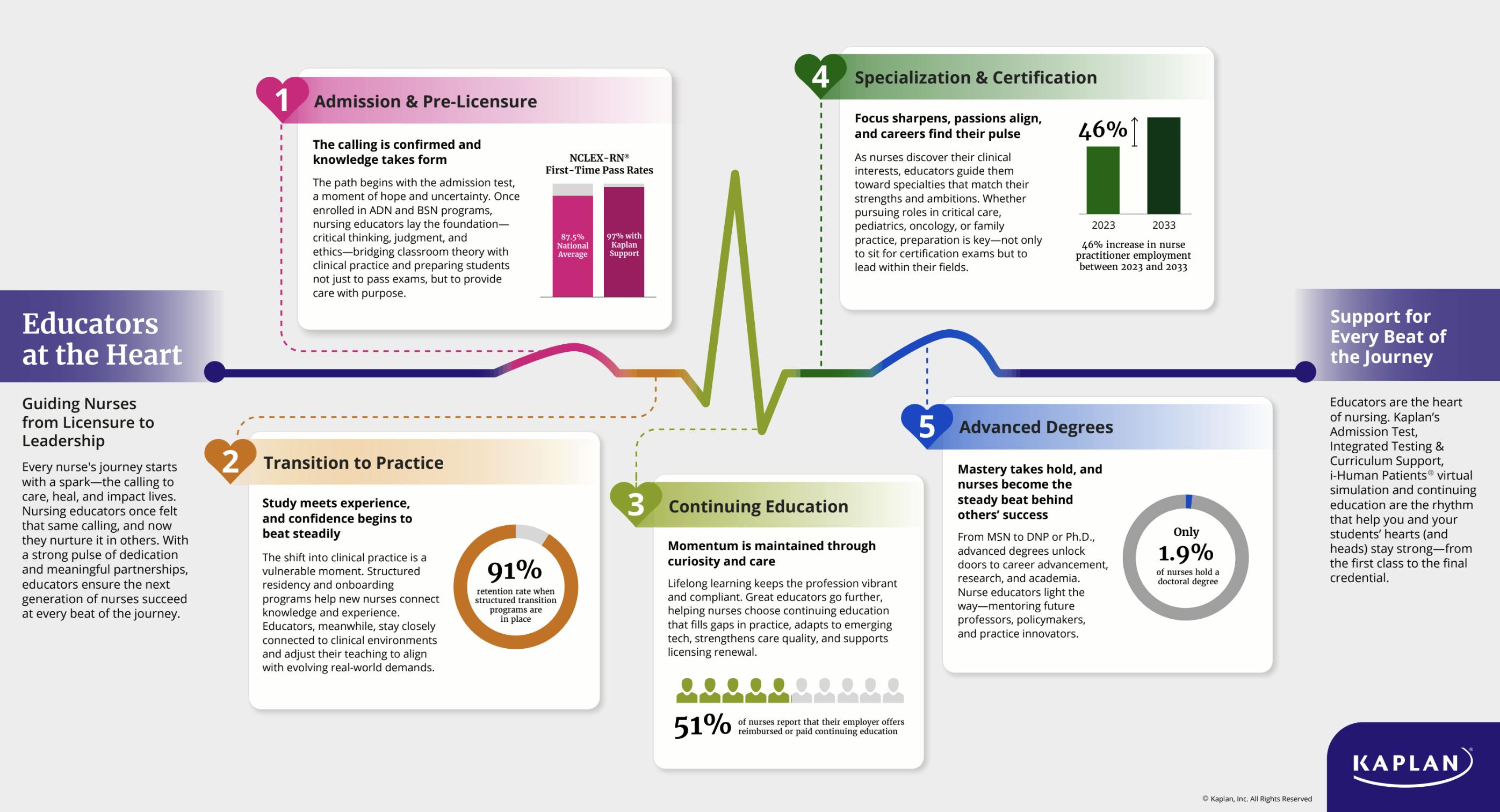
The nursing journey can be seen as six interconnected stages. At each step, educators provide structure, encouragement, and opportunities for growth that prepare nurses for long-term success.
Stages include:
- Admission & Pre-Licensure: Students begin with admission tests and foundational coursework. Educators build critical thinking, judgment, and ethical reasoning from day one.
- Transition to Practice: Moving into clinical roles can be daunting. Structured residencies and mentorship reduce stress and help new nurses adjust with confidence.
- Continuing Education: Lifelong learning ensures nurses keep pace with new technologies, evidence-based guidelines, and evolving care standards.
- Specialization & Certification: As nurses discover areas of passion, educators help connect their skills to advanced roles through specialty preparation and certification pathways.
- Advanced Nursing Degrees: Graduate programs, from MSN to DNP and PhD, prepare future leaders, researchers, and faculty. Educators mentor learners as they navigate these rigorous steps.
- Leadership: Ultimately, many nurses move into leadership roles. Educators remain central in shaping their ability to lead teams, influence policy, and drive innovation in care.
Nurse Educator Journey FAQ
How do nurse educators impact NCLEX pass rates?
By teaching critical reasoning and connecting classroom learning with clinical application, educators help students approach the NCLEX with stronger skills and confidence.
Why is transition-to-practice support so important?
The first year is often the most challenging. Residency programs and mentorship smooth the shift from school to practice, improving retention and easing stress.
What role do educators play in continuing education?
They encourage lifelong learning, helping nurses adapt to new practices and technologies while closing gaps in care delivery.
How do educators support specialization and certification?
By guiding learners toward areas that match their strengths and career goals, and by providing direction on how to prepare for certification milestones.
Why are educators central to the nursing workforce pipeline?
Educators influence every stage of a nurse’s career, ensuring the profession remains strong, adaptive, and ready for future challenges.
Written by Kaplan Nursing experts, reviewed by Dr. Christi Doherty DNP, RNC-OB, CNE, CHSE, CDP. Dr. Doherty is the Executive Director of Nursing & i-Human Patients at Kaplan North America. She is a skilled researcher, valued professor of nursing, experienced clinical nurse, and designer of virtual simulations. Dr. Doherty has earned certifications in nursing education, healthcare simulation education, diversity, and inpatient obstetrics.